IIM Udaipur Report: General Category Enrolment Falls by 11.42 Lakh as India’s Higher Education Expands — Where Are the Students Going?

IIM Udaipur Report: General Category Enrolment Falls by 11.42 Lakh as India’s Higher Education Expands — Where Are the Students Going?

FOR IMMEDIATE RELEASE

November 10, 2026

Location

New Delhi / San Francisco 

CASTEFILES USA | PRESS RELEASE | NOVEMBER 2026

NEW DELHI / UNITED STATES — Even as India's higher education system added over 36 lakh students between 2020–21 and 2023–24, General Category enrolment, including Economically Weaker Sections (EWS), fell by 11.42 lakh. This striking divergence, revealed in an updated IIM Udaipur analysis of All India Survey on Higher Education (AISHE) data, raises a critical question: Why is General Category enrolment declining as India's higher education system expands?

The Enrolment Shift: 2020–21 to 2023–24

Category

2020–21

2023–24

Change

SC

58.95 lakh

69.72 lakh

+10.78 lakh

ST

24.12 lakh

28.83 lakh

+4.71 lakh

OBC

148.22 lakh

180.35 lakh

+32.13 lakh

General + EWS

182.52 lakh

171.11 lakh

−11.42 lakh

Total

413.81 lakh

450.01 lakh

+36.20 lakh

Figures rounded to two decimals; Source: AISHE social-category enrolment data, from the IIM Udaipur analysis.

In 2023–24, SC/ST/OBC students together represented approximately 62% of higher education enrolment, compared with 43.2% in 2010–11. General Category students, including EWS, accounted for approximately 38%, down from 44.1% in 2020–21—a decline of 6.1 percentage points. In absolute numbers, General Category enrolment fell by 11.42 lakh, or approximately 6.3%, during the same period.

The Enrolment Equation: Who Benefited from India's Higher Education Expansion?

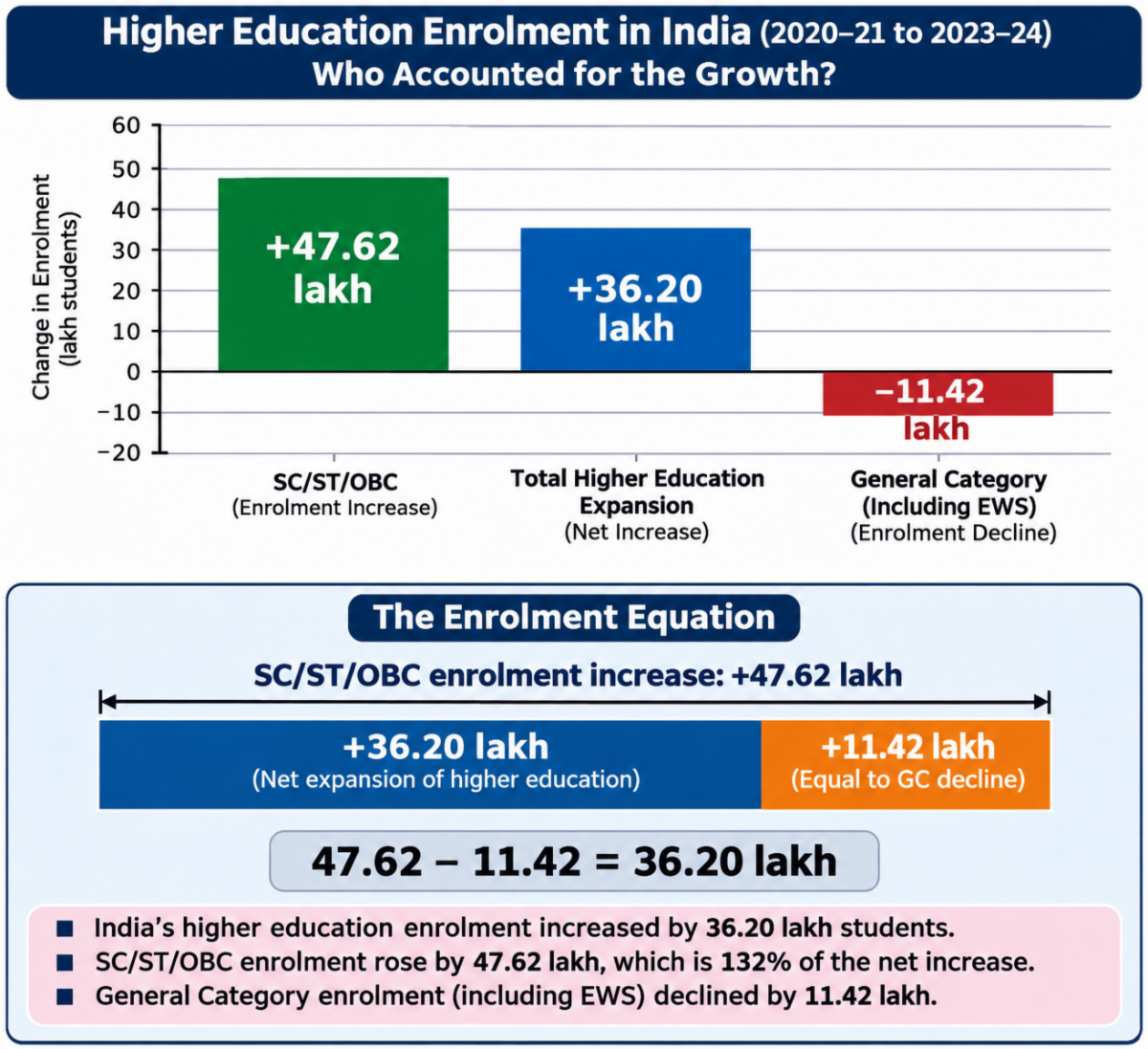
The updated IIM Udaipur analysis reveals a striking Enrolment Equation. 

Graph 1. The Enrolment Equation: national enrolment changes, 2020–21 to 2023–24.

SC/ST/OBC enrolment increased by 47.62 lakh, exceeding the total national enrolment expansion of 36.20 lakh by 11.42 lakh. This exactly matches the 11.42 lakh decline in General Category enrolment. Although the figures do not establish direct causation or a transfer of seats, they raise questions: How many SC/ST/OBC students qualify for open-category seats on merit? Does the pattern differ across states?

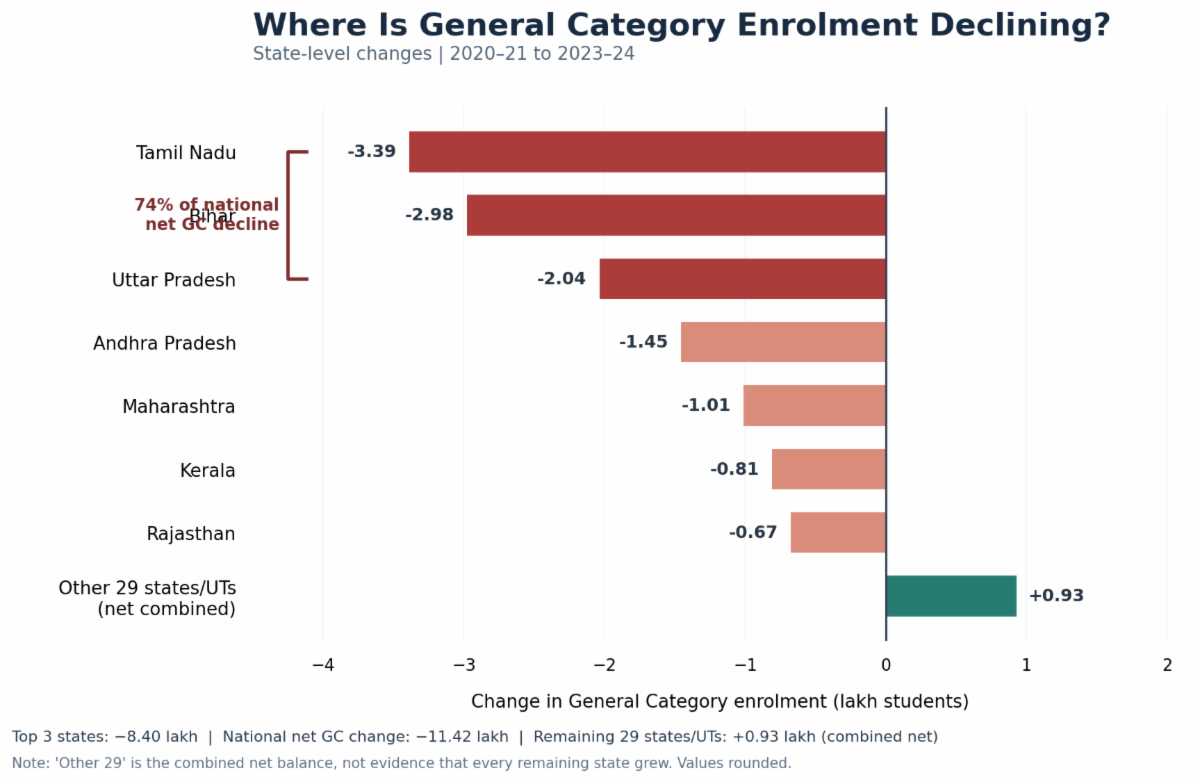
Three States Account for 74% of India's Net General Category Enrolment Decline

Seven states (see Graph 2) recorded a decline of 12.35 lakh in GC enrolment, exceeding the national net decline of 11.42 lakh over the last four years. Gains elsewhere partially offset these losses.

Graph 2. General Category enrolment change across states and union territories, 2020–21 to 2023–24.

Tamil Nadu, Bihar and Uttar Pradesh emerge as bellwether states, together recording a decline of 8.40 lakh in merit enrolment, equivalent to 74% of the national net decline between 2020–21 and 2023–24.

Tamil Nadu leads with a decline of 3.39 lakh. Tamil Nadu has maintained a 69% reservation framework for decades. Its longer-term figures are particularly striking: General Category enrolment fell by nearly half, or 47%, between 2010–11 and 2023–24, while SC/ST/OBC students came to account for 87.26% of the state’s higher education enrolment.

Bihar recorded a decline of 2.98 lakh, against the backdrop of its 2023 caste survey. The Patna High Court struck down Bihar’s subsequent attempt to increase reservations from 50% to 65% in 2024. Uttar Pradesh recorded a further decline of 2.04 lakh.

Together, these three states raise a critical question: Why is General Category enrolment contracting so sharply, and what role might reservation policies, creamy layer, open-category competition, educational costs and student mobility play in these changing patterns?

Why Are General Category Numbers Falling?

“Today, General Category people are the real oppressed and the victims of institutionalized discrimination.” says Dr Neha Das, a prominent social media commentator and member of Youth for Equality, a group fighting against attempts to increase the 50% reservations cap in several states. “This decline is the direct outcome of years of marginalization and discriminatory policies by the state.”

Legally and conceptually, open-category seats do not belong exclusively to General Category students; they are available to everyone who qualifies on merit.  Given that SC/ST/OBC reservations are generally at or below 50% in many states, why has General Category enrolment fallen to 38%? Are more SC/ST/OBC students qualifying for merit seats? The IIM Udaipur study cannot answer this question because AISHE does not distinguish between merit-based and reserved admissions.

Venkatramanan Krishnamurthy, a faculty member in Quantitative Methods and Information Systems at IIM Udaipur and co-author of the report, points to other challenges faced by General Category students even before college.

“In addition to reservation benefits, SC, ST and OBC students have access to various scholarship, hostel and free coaching schemes, while General Category students are often excluded from these category-specific benefits.”--Prof. Venkatraman, study co-author

Are some GC students unable to continue their studies because of inadequate financial assistance or academic support? Is financial support under EWS provisions sufficient to address these concerns?

CasteFiles founder Richa Gautam asks whether missing general category students are turning to overseas education because of constrained domestic options. The Carnegie Endowment’s 2020 Indian American survey reported 83% General/upper-caste share among caste-identifying Hindu Indian American respondents.

“It is easy to say that GC students come abroad seeking greener pastures. I have seen several cases of general category students supporting their US education through expensive loans or sale of ancestral land. They often have no option in their homeland.”-Richa Gautam, Founder, CasteFilesUSA

Other possible explanations include declining birth rates, students choosing vocational education, or entering employment instead of higher education.

Without more detailed AISHE or government research, the reasons for the decline remain uncertain. This is why the proposal for a General Category commission, supported by Reservation Hatao Andolan warrants examination.

Why Are General Category Numbers Falling?

The Reservation Hatao Andolan (RHA) is an on going reservation reforms movement primarily on Instagram and widely discussed on Reddit. Supporters of the viral campaign against reservations argue that the current system neglects merit, fuels systemic division, and should transition toward a needs-based or economic mobility index to help poor families across all backgrounds. 

The movement’s reform charter outlines 12 proposals, including a National Commission for General Category(NCGC) to address General Category interests and grievances.

RHA campaigners such as Anuradha Tiwari and Ajeet Bharti have argued for economically based reservations and a caste-neutral framework. Their proposals also include “One Family, One Reservation, One Time” restrictions, creamy-layer exclusions, and a 10-year sunset clause intended to limit repeated benefits across generations.

A Call for Evidence-Based Review

Better data is essential. Alongside the proposed NCGC, the RHA call for a White Paper on Reservation Status could support further analysis of General Category enrolment trends and the effectiveness of existing reservation policies.

“Social policy must be driven by data to be efficient and effective.” says American sociologist Dr Salvatore Babones.

CasteFiles calls for an in-depth investigation into why General Category enrolment is declining, including whether qualified students face financial or other barriers to higher education. An annual report should document sanctioned seats and actual admissions through merit-based open and reserved pathways, category-wise scholarship eligibility and uptake, age-specific population estimates, state-level enrolment trends, and international student mobility. The decline warrants investigation rather than assumptions about its causes.

“The AISHE analysis reinforces the importance of an evidence-based approach to equity and the urgent need to revisit policy frameworks in light of these new realities.” — Prof. Dina Banerjee, Co-Head, CDPM, IIM Udaipur

About the IIM Udaipur Study

The updated study, Caste-Based Enrolment in Indian Higher Education: Insights from AISHE Between 2010–11 and 2023–24, was prepared by the Centre for Development Policy and Management at IIM Udaipur. It follows the institute’s November 2025 analysis and examines changes in higher education participation across administrative social categories.

https://cdpm.iimu.ac.in/wp-content/uploads/2026/10/Caste-Based-Enrolment-in-Indian-Higher-Education_Insights-from-AISHE_UPDATED.pdf

About CDPM, IIM Udaipur

The Indian Institute of Management Udaipur (IIM Udaipur) is an ‘Institution of National Importance’ established by the Government of India in 2011. IIM Udaipur has established a Centre of Excellence, called the Centre for Development Policy and Management (CDPM), to promote academic research and allied initiatives in broad areas of development studies and related disciplines. For interviews and technical queries: venkatramanank2001@email.iimcal.ac.in.

About CasteFiles USA

CasteFiles is an independent public policy and research think tank examining caste classification, institutional accountability, civil rights, and the use of social categories in public policy. Founded by Richa Gautam and Abhijit Bagal, its work combines research, legal advocacy, and critical examination of institutional decision-making.

Media contact: info@castefiles.com | castefiles.com

Abhijit Bagal

Legal Director

CasteFiles

919-917-3839

Abhijit.bagal@castefiles.com

Richa Gautam

Founder Director

CasteFiles

720-375-1897

info@castefiles.com

Twitter  Instagram