|
Historically, centuries of colonial exploitation left vast sections of India impoverished. Reserved quotas were conceived as a temporary corrective mechanism to address this inequity in free India. However, the rigid structure of reservations has produced a growing “creamy layer” that often displaces the more disadvantaged within the same categories.
Chief Justice of the Supreme Court of India B.R. Gavai, who retired in November 2025, has repeatedly emphasized the necessity of applying the creamy-layer principle to SC and ST categories: “If benefits go repeatedly to the same families, a class within a class emerges. Reservation must reach those who truly need it.”
Thiyagarajan, one of the authors, echoes this view: “AISHE data reveals that availability of opportunities for SC, ST, OBC students in Higher Education is not an issue anymore—it is above average. Now the focus should be to ensure that the creamy layer amongst them does not take away the opportunities of those in the lower rung.”
There is currently no official definition of the creamy layer for SC/STs. Though it is defined for OBC, the criteria leave wide room for manipulation of reservation benefits. Hence, Mr. Gavai has urged policymakers to formally identify and exclude the ‘creamy layer’ from affirmative action benefits.
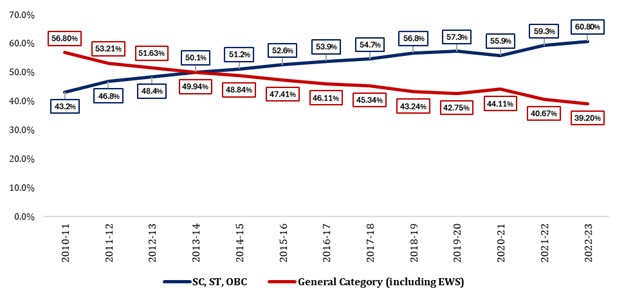
CasteFiles’ analysis of the AISHE report finds that SC/ST/OBC students constitute 62.2% of enrolment in government institutions and 60% in private institutions, indicating that the shift is broad-based and not confined to specific courses or geographies. The report provides detailed state-level patterns confirming this transition.
The General Category not only shows a year-on-year decline in absolute enrolment but also faces significant competition from SC/ST/OBC students who are competently acquiring general seats on merit.
CasteFiles calls upon media outlets, research institutions, universities, and human-rights organizations to engage with this data honestly and rigorously. Claims that “upper castes dominate higher education” are empirically incorrect and have often been used to justify misleading caste-atrocity narratives, policy pressure campaigns, and academic misinformation.
Prof. Dina Banerjee, Co-Head of CDPM at IIM Udaipur, highlights the significance of these trends: “This analysis reinforces the importance of an evidence-based approach to equity and the urgent need to revisit policy frameworks in light of these new realities.”
“Social policy must be driven by data to be efficient and effective,” says Dr. Babones.
ABOUT CDPM, IIM UDAIPUR
The Indian Institute of Management Udaipur (IIM Udaipur) is an ‘Institution of National Importance’ established by the Government of India in 2011. IIM Udaipur has established a Centre of Excellence, called the Centre for Development Policy and Management (CDPM) to promote academic research and allied initiatives in broad areas of development studies and related disciplines. To access the report, click here. To engage with the research team and for interviews and technical queries, please contact venkatramanank2001@email.iimcal.ac.in
ABOUT CASTEFILES, USA
CasteFiles is an academic think tank and research platform committed to producing rigorous, data-driven research on caste-related discourse in global academia, policy, and civil society. Founded by Richa Gautam and Abhijit Bagal, CasteFiles integrates interdisciplinary methods with decolonial analysis to challenge reductive or racialized interpretations of Indian Americans. For media inquiries, please contact CasteFiles at info@castefiles.com.
|